Try Everything Once.
You'll live a longer, fuller, more vibrant life.

Today I’m launching a new series called Try Everything Once. In it, I hope to build on the magic of Make America Burpee Again—the excitement of trying something new, the thrill of enduring something difficult, the joy of the relationships that result.
Come for the sweaty-faced adventure stories, stay for the monthly MABA-esque challenges and embrace the community we’re creating through them.
If you like this newsletter, please share it with friends. I’d love it if you “like” these pieces, comment on them and become a paid subscriber.
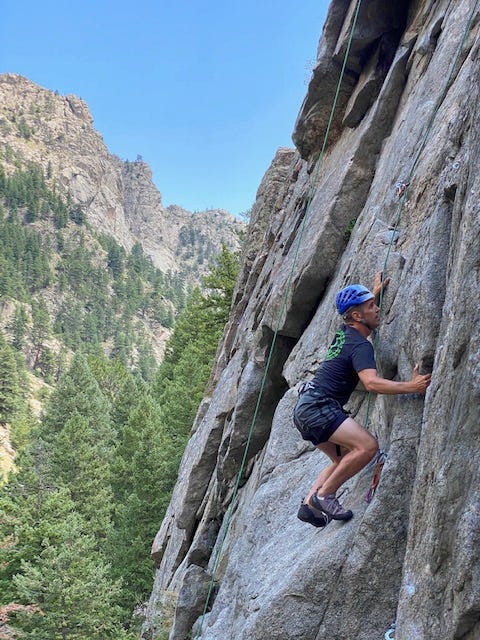
The pitch is called Nurse Jackie, probably after the TV show of the same name, but who knows? It’s a 50-foot rock climb in Colorado’s Boulder Canyon, and it is, by world champion paraclimber Mo Beck’s standards, easy.
And yet when she climbed off of that pitch on a glorious July morning, Beck, one of the 2019 National Geographic “Adventurers of the Year,” glowed with excitement. I asked about the joy splattered across her face.
“Climb it,” she said. “And then ask me again.”
I stepped up to the wall. The first 8 feet were close to straight up, difficult for a beginner like me, even with obvious spots to grab onto. After that, the wall turned in a few degrees, still too steep to climb without ropes but not by much. I threw my right hand out, then my left foot, then left hand, then right foot, feeling like I imagine Spider-Man feels when he scales skyscrapers.
I smacked the top with my right hand, rappelled down and arrived at the bottom as if I had just conquered Mount Everest.
I didn’t have to ask Beck about her joy again because now I felt my own.
But that shared joy prompted more questions. What in the world was going on with me? Did I just become a rock climber and why did it feel so awesome? Why could I remember every crack, crevice and cranny of Nurse Jackie’s face? Why, in the hours after, did I talk 100 miles per hour? Why did the climb, which sped by as I did it, now seem like it lasted much, much longer? And why did I feel similar sensations after most, if not all, of my adventures, especially but not only the ones that were new to me?
I thought I had simply learned a new skill, albeit an exciting one. But there was so much more going on than that.
In fact, there is fascinating brain research that shows that trying something new isn’t just fun and energizing, it makes our lives better in myriad other ways—prolonging our lives, restructuring our brains, and preparing us to learn the next new thing.
I will explore all of that in a series I am launching today called Try Everything Once. In the coming weeks I’ll take you surfing and ice climbing and hang gliding and golfing and hot air ballooning and more. I’ll explore the Northern Lights in Alaska and family history in Italy and the miracle (and mess) of birth at a dairy farm in Missouri. Sometimes the stories will be straight up adventures, sometimes the adventures will be embedded within a larger story, and sometimes I’ll take you on bucket list trips.
They all with have one goal in common: To encourage you to chase new and novel experiences.
--
The best part about being a journalist is you never have the same day twice. I used to describe it as like getting to do a book report on a new book every day, which I would love to do. I stopped saying that when I realized people thought that sounded boring as hell. So now I say it’s like getting to go to a cool place or have a thrilling adventure or meet an interesting person every day.
In my first newspaper job, I covered an entire city, so there was a chance to do, see or learn something new every day, and sometimes more than once. One morning, I wrote on deadline for that afternoon’s paper about an overnight drug bust in which cops seized cocaine, guns and money (to say nothing of bad guys). Later that day I visited an elementary school to interview fourth graders who wrote a book about Michigan.
In 13 years at The Sporting News, I bounced from football to baseball to basketball to hockey to NASCAR and loved it because of the variety. When I became a freelance magazine writer in 2013, conventional wisdom said I should specialize—become a go-to, authoritative expert on one topic. That sounded like a terrible idea. I would be bored out of my mind.
And there’s growing research that shows too narrow of a focus isn’t as valuable as once believed. Part of the allure of being a specialist is modern culture makes heroes out of experts, and for good reason. They know their stuff and command respect in their fields. But when they run into problems they can’t solve, an over-reliance on the cult of the expert might actually be counterproductive.
In Range, David Epstein writes if you are struggling with a narrow problem in a niche field, somebody who knows little to nothing about that field might be better at solving the problem than you are. That’s because the more we know about something (“the inside view”), the poorer our decisions are about it, especially when it comes to problem solving. “Relying upon experience from a single domain is not only limiting, it can be disastrous,” Epstein writes.
I cast (and still cast) a wide net. That might be bad for my writing business, but it is great for my life. I write about soldiers and beauty queens and car collectors and singers and athletes. I write about new-to-me places, foods and hobbies. I love asking people about what they love and why they love it, particularly when that subject is something I know little or nothing aobut.
This “write about things new to me” approach was a coincidence at first—I didn’t recognize I was doing it. Editors said yes to these ideas, so I kept pitching them. I was looking to make a living, not a life. But then I realized how much fun I was having, and I started to do it on purpose.
I had never been to Alaska, so I concocted a way to get there. Same for Utah, North Dakota and Hawaii. I became a professional novice. I dove into genealogy. I went on an archaeological expedition. I worked as a roadie. I shoveled pig shit and learned to fight bulls. I rode my bike across Missouri, hiked across Wisconsin, paddled across Nebraska and climbed (part way) up a 90-foot red oak named Willa. I did underwater training with professional bull riders. I went paddleboarding, off-road driving, dog mushing and much, much more.
I chased experiences I’d only ever get to do once—covering bull riding on an aircraft carrier in the middle of a pandemic, rucking blindfolded in the middle of the night during torrential rain, traveling to a foreign country and trying to speak the language there, etc.
I did it for fun, I did it for money, I did it because it allowed me to live a well-rounded and exciting life.
I didn’t realize how good it was for me mentally, physically and emotionally.
When we experience something new and like it, our brain triggers a release of dopamine. Dopamine makes us experience pleasure. I suppose we all know this now because of how social media makes us feel when we get likes. Let me just say the dopamine from running off a cliff to go paragliding is SO MUCH BETTER.
And the benefits of doing something novel extend beyond just feeling good. Learning makes our brains better. “Every time you learn a new fact or skill you change your brain,” says Lara Boyd, director of the Brain Behaviour Lab at the University of British Columbia, in a Tedx talk called “After This Your Brain Will Not Be The Same.”
The harder a skill is to learn, the better it is for your brain. “My research has shown that increase in difficulty, increased struggle if you will, during practice actually leads to both more learning and greater structural change in the brain,” Boyd said.
--
Sometimes I learn something new, do it once or twice, and never try it again, either because I didn’t like it (whitewater rafting) or never have a chance to do it again (dog mushing). Sometimes the something new is a standalone thing, like hang gliding. And sometimes I learn something new in pursuit of some other end.
I try to be ready “just in case,” as in, just in case I land an assignment that requires me to be able to do X, I can do it. When I first started writing about adventure, I recognized I lacked the ability to camp alone. So I “practiced” so I would be ready if an editor asked me to write a story that required me to camp alone … which has now happened in Maine, Nebraska, Texas and Utah.
The first few “practice” times were in campgrounds where I had neighbors.
Was it creepy? Yes.
Sleeplessly creepy? No.
Then I posed a big test for myself: I camped in the “outback” by myself.
White Sands National Park is 275 miles of rolling gypsum sand that looks for all the world like the Arctic. And the night I spent there alone, it felt like it.
I watched the sun set behind a ridge, and when the last rays of purple faded, the world turned black and white. The stars were vibrant, so I pulled my sleeping bag out of my tent and planned to sleep under them. I figured that would let me practice another skill—sleeping outside.
I pulled my winter hat tight over my ears. The condensation from my breath froze on my sleeping bag. A shooting star shot across my vision, left to right, for so long I turned my head to watch it go. It disappeared behind my tent.
I turned my gaze from the lights of infinity to the light right in front of me — my Kindle, into which I had loaded Frankenstein. The book begins and ends with Victor Frankenstein chasing his monster across a vast, frozen, desolate landscape. I looked at the vast, frozen, desolate landscape that surrounded me … I listened to the silence … I imagined what monster might be being chased just beyond that ridge where the sun set … and freaked myself right out.
I climbed back into my tent.
I bring this up because that experience lives much, much longer in my memory than the events would otherwise warrant.
Why is that? Why do the moments during and after new and exciting adventures feel so heavy, so profound, so clear, so long?
John Coyle has a mind-bending answer to those questions. He is an Olympic short-track speed-skating silver medalist and an expert in design thinking, a way of problem-solving with the user experience in mind. The problem he tries to solve is how to fill time with more memorable and exciting experiences.
The title of his book speaks to how we experience time: Counterclockwise: Designing Endless Summers. Our childhood summers seem endless because everything was new. Coyle argues that the value of an increment of time is not related to its duration. Instead, Coyle says, we should define an increment of time by the events that fill it — the moments that become indelible in our lives — and then live our lives to pursue those moments.
Think of time as like boxes in your basement. The full boxes contain vivid memories—of rock climbing, 3,100 burpees in a month, weddings, births, deaths, worrying that Frankenstein’s monster is going to kill you in New Mexico—and mark great days in your life. But some boxes are empty. They’re not even open yet, they’re just flat pieces of cardboard. These are days you don’t even remember. That time is blank, empty, void. “That’s equivalent to being dead, in my book,” Coyle told me.
What if, Coyle argues, we lived our lives in such a way as to intentionally fill as many boxes as possible? How many could we fill up, and with what?
To answer those questions, we must first understand how our brains create and store memories. Under normal circumstances, every two or three seconds, the hippocampus — a region of our brain related to learning and memory — takes a Polaroid, to use Coyle’s way of explaining it. A photo slides out, and the hippocampus decides whether to store it or pitch it. Most are pitched.
When something exciting happens the amygdala turns on. This brain region, which regulates emotion, takes Polaroids 20 times per second. That turns into a strong memory because the amygdala ties emotion to memory. There’s one more step after the amygdala turns on, commonly referred to as the flow state, in which you take Polaroids 150 times faster than normal, creating your most powerful memories.
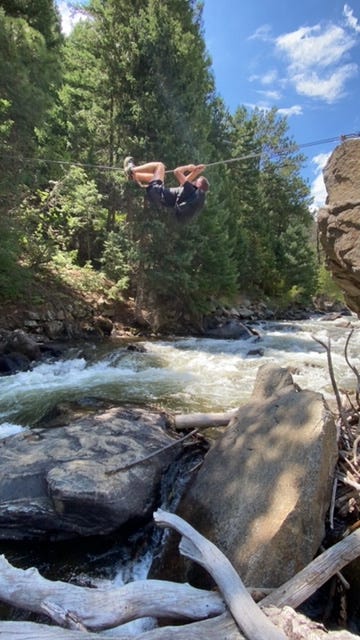
Here’s where it gets fascinating. There is an inverse relationship between how we experience an event and how we remember it. In real time, the drive to the rock-climbing area in Boulder took forever because it was boring, but the box of that memory is empty. And yet the Tyrolean traverse (see photo) we completed to cross a raging creek to get there took only a minute or two but feels like it took much longer because the box is full to overflowing.
Think again of the boxes in your basement. Each full box represents as much time as an empty one in a literal sense. The fuller the box, the longer the memory, the longer it seems like you lived. “There’s a before and after, which then necessarily extends people’s perception of time on this planet,” Coyle says. “That’s a pretty heavy gift to give somebody.”
And that’s the gift I hope you give yourself after reading this Try Everything Once series.
This month’s challenge that I hope you’ll join me on
100 miles on my feet. I signed up for the GWOT 100, which honors men and women who served during the Global War on Terror.
I will use this time to train toward a goal. About 10 years ago, I covered a team-based Army competition. I watched in awe as the engineers blew stuff up—a perfect example of Try Everything Once assignment.
One of the events required the soldiers to ruck 12 miles in three hours carrying 35 pounds in their packs. I wanted to walk alongside them for the duration because I knew whatever I saw and/or heard would be great for my story. But I could not keep up and had to quit after about a mile. That was the first, and still only, time I have had to bail on an assignment for physical reasons. I vowed I’d never do that again.
The resulting fitness revolution in my life led to MABA, this newsletter, etc. So I’m going to put the time on my feet in GWOT to good use: In early March, I’m going to attempt to hike 12 miles in three hours carrying 35 pounds.
Looking forward to the series. You've had so many adventures you should write a book. I don't recall but have you experienced an active volcano yet? Steve